

Waterjet Cutting Explained: The Mechanics Behind Precision CNC Waterjets
What’s Actually Happening Inside a Waterjet Cutting Head
Watch a waterjet cut steel and it looks almost too simple — a thin stream of water, no sparks, no flame, and yet it slices through half-inch plate like it’s nothing. What’s driving that is a fairly precise chain of engineering, and understanding it helps when you’re comparing machines, not just marketing claims.
It starts with the pump
Water gets pressurized to somewhere between 3,000 and 4,000+ bar — 40,000 to 60,000 PSI, roughly. There are two ways to get there. Intensifier pumps use hydraulic oil and a bypass circuit to regulate pressure output. Direct Servo Drive (DSD) pumps skip that step, using a servo motor to drive the pressure stroke directly.
That difference isn’t just technical trivia. A bypass circuit continuously diverts pressurized fluid to keep output steady, and that diverted fluid is energy that never reaches the cutting head — it’s just wasted as heat. Jekran’s DSD 4000 bar pump systems remove that circuit altogether, which means more of the energy you’re paying for actually goes into cutting.
Then the orifice
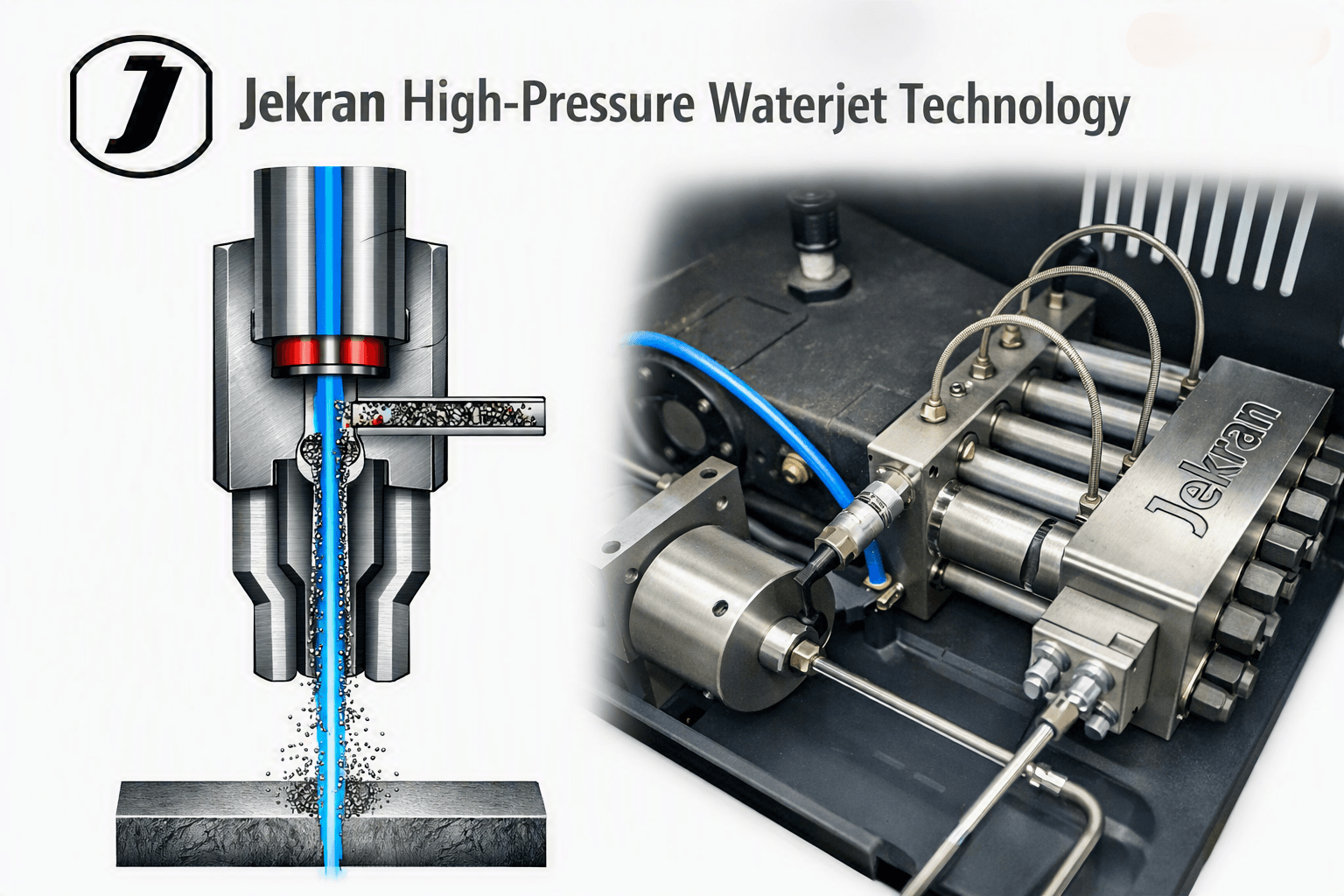
Pressurized water is pushed through a tiny jewel orifice — usually synthetic sapphire or diamond, somewhere between 0.1 and 0.4mm across. That constriction is what converts pressure into speed, and the water comes out the other side moving at roughly two to three times the speed of sound. At this point, before any abrasive is added, you already have a working cutting stream — enough for soft materials like foam, rubber, or food products.
Abrasive, for the harder stuff
Cutting metal, stone, or glass needs more than water alone. The high-velocity stream passes through a mixing chamber, where garnet abrasive gets pulled in — the venturi effect created by the water’s own speed does most of the work here. Water and garnet then travel together through a mixing tube, where the abrasive particles pick up speed until they’re moving close to the water’s velocity, and the combined stream exits the nozzle as one cohesive cutting jet.
Guided by the CNC controller
The head itself rides on a CNC gantry, following a path set by CAD/CAM software that controls speed, direction, and where the jet pierces the material. Decent controllers adjust feed rate automatically based on material and thickness, and they compensate for taper — the slight loss of focus that happens as the jet cuts deeper, which matters a lot once you’re cutting past 25mm.
Where the water ends up
Below the cutting bed sits a catch tank, where spent water and abrasive fall after doing their job. It absorbs whatever energy is left in the jet and cuts down on noise considerably. Some systems recycle a portion of that water, which adds up over long production runs.
Why two machines with the same gantry can cut differently
Put two waterjet machines side by side with identical cutting heads and gantries, and they can still perform noticeably differently — because the pump underneath isn’t the same. Pressure consistency affects edge quality, cutting speed, and how repeatable your parts are from the first to the thousandth. That’s the reasoning behind building Jekran’s waterjet CNC machines around DSD pump technology instead of older intensifier designs.
For readers who want a deeper technical grounding, the WaterJet Technology Association maintains ongoing research and best-practice resources covering the full range of waterjet applications, from cutting to industrial cleaning.
The takeaway
Waterjet cutting is a lot more than “high-pressure water.” It’s pump engineering, orifice precision, abrasive delivery, and motion control all working in sequence — and when you’re comparing machines, the pump is usually the part that decides whether you’ve bought a reliable production tool or a maintenance headache waiting to happen.
Frequently Asked Questions
How much pressure does a waterjet cutting machine use?
Typically 3,000 to 4,000+ bar (40,000–60,000 PSI), generated by an intensifier pump or a Direct Servo Drive pump.
What is a Direct Servo Drive (DSD) pump?
A pump that uses a servo motor to build pressure directly, without the bypass circuit intensifier pumps rely on — the result is better efficiency and more consistent pressure.
Why does the orifice size matter?
The orifice — a small sapphire or diamond jewel, usually 0.1–0.4mm — sets the water stream’s diameter, which directly shapes kerf width and cutting precision.
Why is abrasive added to the water stream?
Water alone can’t cut hard materials. Garnet abrasive, drawn into the stream via the venturi effect, is what lets waterjet handle metal, stone, and glass.
Does waterjet cutting create taper on thick material?
Some, yes — the jet loses focus slightly with depth. Modern CNC controllers compensate for this automatically to hold tolerance on thicker cuts.
How does pump choice affect long-term maintenance?
Intensifier pumps depend on hydraulic seals and bypass valves that wear over time. DSD pumps have fewer high-wear parts, which generally means less frequent maintenance.